Oven Repair
Why a Winchester Wolf Oven Keeps the Door Shut After Self-Clean
A Wolf oven door stays locked after self-clean until the control sees the cavity fall below its safe threshold, and that takes far longer than people expect. Check the display for power, wait the cool-down out properly, and never force the door.
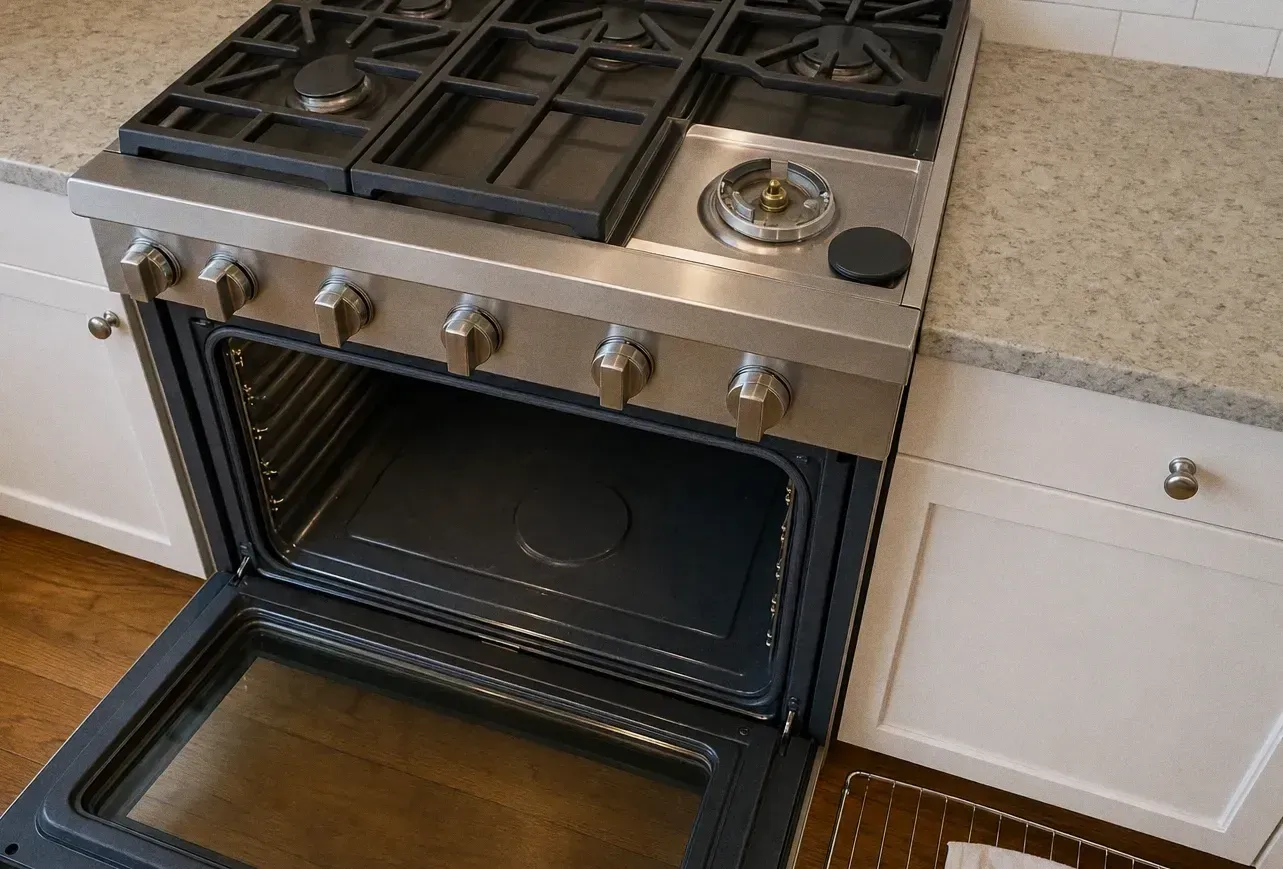
The cool-down is part of the cycle
The lock is released by temperature, not by the clock. The heat switching off changes nothing on its own. The door stays held until the cavity reads below the threshold the control has been told is safe, and a well-insulated cabinet takes a long time to fall that far. So the cycle you think finished at four o’clock has not finished; it has moved into the half nobody watches.
Treat the first stretch as observation rather than troubleshooting. Note whether the display is still lit and what it is showing — a lock indicator, a countdown, a code, or nothing in particular. Listen for a cooling fan, which frequently runs on after the heat has gone and is a sign of an appliance behaving correctly. Put your hand near, not on, the door and get a sense of whether the cabinet is still radiating.
The point at which waiting stops being the answer is when the cabinet has come down to something close to room temperature, the display has stopped indicating anything unusual, and the door is still held. Before that, patience is the repair. The threshold and the expected behaviour differ between series, so the figure to trust is the one in the use and care guide for your own model rather than a number from a neighbour.
Winchester houses stretch this out more than most. The 1920s tudors and stone-and-stucco colonials up in the Highlands hold heat well by construction, and a cabinet built into an interior run in a Wedgemere rear kitchen has very little around it to carry warmth away. A cook who ran the cycle in a draughty summer kitchen years ago and remembers it clearing quickly is comparing two different buildings.
A blank display changes the diagnosis
Look at the panel before you form any theory about the latch, because a lit panel and a dead one describe two unrelated problems. If the controls are awake and responding, you are dealing with a lock that has not released. If the panel is dark and nothing responds, the appliance has lost power, and the latch is simply where a dead machine happened to leave the door.
For a dark panel, the breaker is the first stop. Reset it once — as a test, not as a fix. If everything comes back and stays up, you have learned that a fault drew more current than the circuit would carry, and you will want to know why before running anything demanding again. If it lets go a second time, leave it off and call. Cycling a breaker repeatedly into a live fault is how a modest repair becomes a larger one.
If the breaker is fine but the panel is still dead, a thermal fuse is the usual suspect. It is a deliberately sacrificial part: when a temperature limit is passed it opens the circuit for good, and that is the end of it — there is no reset button, only replacement. Finding one blown after a cleaning cycle is not evidence that the appliance is poorly made. It is a safety device performing exactly the function it was fitted to perform, and the interesting question is what got hot enough to trigger it.
That question is why this article is framed as it is. The heavy cycle rarely creates faults out of nothing; it exposes the components that were already close to their limit and would have failed on some other busy day instead.
The mechanism behind the door
Once power is confirmed and the cabinet is genuinely cool, the latch itself is what remains, and it is easier to understand as a conversation than as a component. A small motor drives the latch bar across. A switch watches where it ends up and reports back. The control refuses to consider the door openable until that report says what it expects to hear.
Two failures follow from that arrangement, and they sound different from the kitchen. One is silence: the unlock is commanded and nothing whatsoever moves, which points at the motor or at what is driving it. The other is movement without release — a brief whirr or a click, then nothing, which suggests the mechanism went somewhere but the switch never confirmed the position the control was waiting for. Both leave you with a closed door; only one of them involves a motor that has stopped working.
There is a third case that belongs specifically to what has just happened. The cavity has been driven far above any temperature you would cook at, and metal at those temperatures moves. A latch that ran freely last month can bind on a track that has distorted slightly, or on soil that baked hard into the path it travels. Faults of that kind sometimes free themselves as everything returns to room temperature, which is one more reason not to intervene early.
Where you must stop is here. You are dealing with a machine that draws heavy current and has just spent hours at a temperature nothing in the kitchen matches, and its latch shares a control with the elements. Nothing behind the trim rewards a homeowner’s inspection. Reading behaviour from the outside is sensible; going after it is not, and it is where the Wolf Oven Repair work begins.
Timing the cycle so a failure is survivable
Our position on the cycle itself is not that you should avoid it. It is that the cycle is the most demanding thing the appliance is ever asked to do, and anything already marginal — a tired element, an aging fuse, a hinge that has lost tension — has a good chance of declaring itself during or shortly after it. Knowing that changes when you press the button, not whether.
The practical rule is simply not to run it against a deadline. A Mystic Lakes kitchen rebuilt around an island cooking suite and expected to feed a dozen people on Saturday should be cleaned on Monday, with the whole week in hand. In a tight Winchester Center grid house where the kitchen is at the back down a hallway and there is exactly one appliance to cook in, that margin matters even more. Run the cycle when a failure would be an inconvenience rather than a crisis, and it usually stays an inconvenience.
Manual cleaning is a legitimate alternative and not a lesser one. Wiping the cavity while it is still faintly warm after cooking, and dealing with a spill in the week it happens rather than the season after, keeps most cabinets acceptable and means the heavy cycle is needed far less often. That is maintenance advice, not criticism of a feature that works perfectly well when it is used with some forethought.
The symptoms that end the DIY stage
Three things move this out of the waiting-and-watching category. A smell of hot wiring or scorched insulation, which is nothing like the odour of residue burning away inside the cavity. A breaker that lets go for a second time. And a door still firmly held long after the cabinet is cool to the touch and the display has settled.
Do not force it, and here is the plain reason: the latch is not built to be overridden from outside. Levering the door drives the load through the latch assembly and the door itself, so a single replaceable component becomes two costly ones, and you can finish with a door that will not seal properly even once it is open — which turns a lock fault into a heating fault.
A visit settles what the outside of the appliance cannot show. We check continuity across the thermal fuse, watch whether the latch motor is being commanded and whether it responds when it is, and read what the control is asking for at each step of the sequence. With a meter that is a short piece of work; without one it is guesswork. The diagnostic call is $95.
We cover Winchester Center, Wedgemere and Winchester Highlands. Reach us on the telephone number above, or through the booking link that sits with it.
Still asked on the phone
Can I force the door open?
No. The latch is not built to be released by hand, and levering it drives the whole load through the latch assembly and the door itself, so one replaceable part becomes two costly ones. Worse, a door that has been forced may no longer seal against the frame, which converts a lock problem into a heating problem. Wait out the cool-down, then call.
What is a thermal fuse and why did it blow?
It is a one-shot safety device that opens the circuit permanently once a temperature limit is passed, and it cannot be reset — only replaced. It goes because something near it grew hotter than it should have, which is why a cleaning cycle so often comes immediately before. The fuse doing its job is the good news; what let the temperature climb is the question worth answering.
The oven opened but now will not heat — are the two related?
Very likely. The conditions that held the door shut can also take out something that only shows itself when you next ask for heat — an element that failed under load, a fuse that opened, or a relay that stopped closing. Report both symptoms together when you call rather than treating them as two separate visits, because they usually share a single cause.